
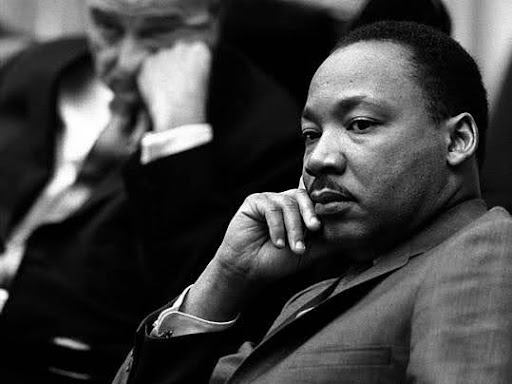
In 1967, Martin Luther King Jr. expressed a profound sense of despair in his final published book, “Where Do We Go from Here? Chaos or Community.”
One might expect this to have been a time for celebration, given that his movement had successfully achieved the passage of major Civil Rights legislation: the Civil Rights Act of 1964, which outlawed discrimination based on race, color, religion, and the Voting Rights Act of 1965, which outlawed discriminatory voting practices like literacy tests.
Yet, King was disheartened, believing little had changed. He stated that although laws declared rights, they did not deliver them: “Every civil rights law is substantially more dishonored than honored.” Progress in school desegregation was minimal. His main complaint was that though the legal barriers to opportunity might have been broken, the severe socioeconomic conditions of the Black poor—including persistent poverty, slum housing, and massive income inequity—remained unchanged.
He averred that throughout U.S. history, laws affirming “Negro rights have consistently been circumvented by ingenious evasions which render them void in practice.”
One example he may have had in mind was the critique that, though the Civil Rights Act prohibited explicit racism, it did not measure outcomes. For example, job descriptions could no longer prohibit Black applicants from applying. Still, employers could add qualifications that Black applicants were unlikely to meet. Since there were no quotas or enforcement mechanisms, many Black job seekers still experienced discrimination.
Fortunately, much has changed since Martin Luther King Jr. offered his commentary in 1967. Change was slow—so slow it was imperceptible from King’s vantage point—but change was happening nonetheless.
In the 1960s, overt racism was still rampant. The “N” word was still a part of the everyday language in many White communities. For historical context, the most popular TV show at the time was “All in the Family.” “All in the Family” ran from 1971 to 1979 and was the first show to top the Nielsen ratings for five consecutive years. Norman Lear created Archie Bunker as a narrow‑minded, bigoted racist. Lear wanted audiences to embrace Archie, but reject his racism. It backfired.

The racial parody was lost upon its viewers. Fans loved Archie because of who he was and what he said, not despite it. Viewers bought “Archie for President” bumper stickers and pins. Archie said on national TV what they thought. He said the things they said, behind closed doors, and they loved him for it. In the 60s and 70s, overt racism was still very much alive.
Today, racial slurs and overt racism are strictly taboo, and they find no place in TV comedy. Affirmative Action filled in many of the gaps left by the Civil Rights Act, leading to significant measurable progress:
Educational Attainment: Great strides have been made in higher education. In 1965, only 2% of all college students were Black. By 2020, 12.5% of all college students were Black, which closely matched the percentage of the overall Black population.
Poverty Reduction: In 1959, 55.1% of all Black individuals lived in poverty. By 2020, that percentage was down to 19.5%.
Rising Middle Class: In 1965, between 10% and 12% of the Black population had become middle class. By 2020, that number had grown to 47% of the population.
As a society, we have made progress toward Martin Luther King’s goal of racial equality. But there is still much to be done. While overt racism might be gone, more subtle shades of racism still exist.
For example, Harvard University did two resume studies. In one study, they found that White applicants were 50% more likely to receive a callback than Black applicants with identical credentials. In another study, they discovered that White applicants for entry‑level jobs with one criminal conviction were more likely to get a call back than a Black applicant with identical credentials and no criminal record.
A 2020 study found that White police officers were 60% more likely to use force than Black officers when responding to calls involving minorities. Multiple studies indicate that homes owned by Black individuals often sell for less than comparable homes owned by White individuals. This disparity persists even when accounting for the house’s and the neighborhood’s characteristics. These patterns demonstrate the presence of subtle bias or unconscious forms of racism that still persist.
By citing these examples, I am not implying that White people are inherently racist. Nor am I inferring that racism only runs one way. These examples reflect complex social dynamics that are difficult to sort out. (For example, did the minorities in the 911 calls respond differently to the white police officer? Did their response influence the officer’s use of force?) Racism is the outgrowth of the natural human tendency to feel more comfortable around people who “are like us:” ethnocentrism. This doesn’t justify ethnocentrism; it just means it is a vice that all human beings share.
Instead of trying to solve a complex, subjective issue like racism, we will examine structural racial inequity: the lingering scars of our country’s history of overt racism and Jim Crow Laws. These are things that can be measured, and are what Martin Luther King observed regarding the conditions of the Black poor—including persistent poverty, slum housing, and massive income inequity.
While for many Black families, life is far better today than it was in the 1960s, with a five‑fold increase in the percentage of middle‑class Black families, for the poor Black families growing up in our urban America, things are much worse.
To understand how these invisible barriers compound over time, consider wealth accumulation—the foundation of economic mobility in America. The racial wealth gap is one statistic that illustrates the continuing impact of the Jim Crow legacy. The median White family has $171,000 of accumulated wealth compared to $17,600 for the median Black family. A significant portion of this wealth gap reflects generational wealth accumulated through home ownership. From 1934 to 1968, 98% of FHA loan beneficiaries were White families. Home ownership was a significant source of wealth building. Unfortunately, the gap in home ownership persists to this day. As of 2020, only 45% of Black families own their own homes, compared to 75% of White families. Black families missed decades of wealth‑building through home ownership.
Some of this wealth gap can be explained by the fact that poor Black families are significantly poorer than poor White families. The median wealth of a White family living in the bottom quintile is $11,700. The median wealth for a comparable Black family is $1,300. Whereas only 9% of White folks have zero to negative wealth, for Black families, it is 18%. While about 10% of poor White children live in what are considered high‑poverty neighborhoods, this is the case for 30% of poor Black children. Living in high‑poverty neighborhoods exposes children to more crime, poor housing, more pollution, high‑poverty public schools, and very few job opportunities. These adverse environments make upward mobility much more difficult for poor Black children.
How did urban America get here? The answer lies in a deliberate confluence of policies that systematically impacted northern cities and the black communities that lived there. Understanding this sequence is crucial: the Great Migration, suburbanization, White flight, urban renewal, the construction of the U.S. Interstate system, and the Fair Housing Act of 1968.
Most Northern U.S. cities peaked around 1950. Immediately following World War II, housing demand and the Great Migration became two catalytic factors that led to a gradual urban decline.
After World War II, Black veterans migrated to northern cities in search of better employment opportunities. Contemporaneously, in 1948, builders began to build suburban subdivisions to meet the tremendous demand for housing. The U.S. Interstate system was being constructed, allowing workers to live further away from their jobs. As more Black families moved into northern cities, more White families left – White flight.
Urban Renewal accelerated the demise of our cities. Ostensibly, Urban Renewal was designed to redevelop blighted neighborhoods. In reality, it was used by city planners to demolish thriving Black urban communities to make way for highways, parks, and sporting arenas.
The neighborhoods targeted for Urban Renewal tended to be the well‑established Black communities that bordered White neighborhoods. A prime example of this was the creation of the Lincoln Center in Manhattan. Urban planner, Robert Moses, saw that Urban Renewal gave him a tool to push minority families out of border neighborhoods. In the 1950s, he razed San Juan Hill, a thriving cultural center and working‑class neighborhood for many Black and Puerto Rican Families, displacing more than 7,000 families and 800 businesses. Robert Moses weaponized Urban Renewal throughout New York, systematically demolishing minority neighborhoods for civic projects and highways like the Cross‑Bronx Expressway.
Robert Moses’s Urban Renewal model was widely emulated by city planners across the United States to construct major infrastructure projects and reshape metropolitan areas, often with profoundly destructive results for marginalized communities. His methods included 1) Weaponizing “Slum Clearance” to declare thriving, low‑income, and minority neighborhoods as “blighted” slums, 2) Targeting Displacement of black neighborhoods, and 3) Creating Segregated Barriers to position infrastructure to function as physical and economic barriers that segregated Black families from white neighborhoods and central business districts.
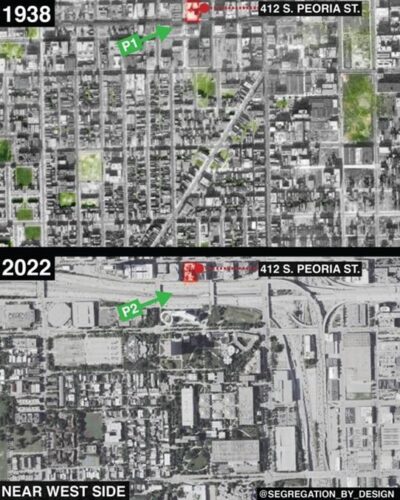
One notable example was Greenwood, Oklahoma, which was known as Black Wall Street. What the 1921 race riots could not accomplish, Urban Renewal did. The Inner Dispersal Loop (IDL), built for Interstate 244 (I‑244), was routed directly through the center of the Greenwood District, a decision that ultimately dismantled and devastated the once‑thriving Black community.
Urban Renewal was responsible for demolishing numerous Black cultural centers and the homes of Black entrepreneurs to make way for highways, including Overtown, Miami (I‑95), Hayti District in Durham (NC‑147), and Paradise Valley in Detroit (I‑75). Urban Renewal displaced and devastated Black communities across the country.
Many Black families were forced to move to poorer, more crowded neighborhoods, living further away from good‑paying jobs. Invariably, Black entrepreneurs were unable to open new businesses in their new neighborhoods. Urban Renewal not only physically moved Black people, but also pushed them from being among the working class to living in poverty. This forced relocation and overcrowding became a catalyst for the Race Riots in the northern cities in the 1960s.
As more and more middle‑class people moved to the suburbs, jobs followed them. By 1967, ¾ of all manufacturing jobs were in the suburbs. After the passage of the Fair Housing Act of 1968, it was no longer just White flight. Black families that could afford to move to the suburbs did. Over time, the only families remaining in our cities were those who couldn’t afford to move. These are the folks that Martin Luther King had in mind when he spoke of the plight of poor Black families remaining unchanged. In reality, their desperate situation had grown worse.
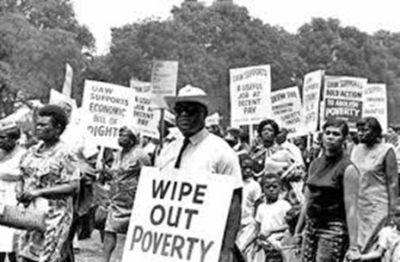
These high‑poverty neighborhoods lead to poor health outcomes. As a result, overall Black life expectancy is 6 years less than White life expectancy. Maternal death rates are twice the national average. Black people are 40% more likely to die of colorectal cancer and 30% more likely to die of cervical cancer.
There is a known correlation between poverty and incarceration. Not surprisingly, Black men are incarcerated at 5 times the rate of White men. Although White and Black youth use marijuana at comparable rates, a Black youth is 6 times more likely to be incarcerated for marijuana use than his White middle‑class peers. There are several reasons for this.
First, police are much more likely to patrol poor Black neighborhoods than middle‑class neighborhoods. Then, upon arrest, Black youth are much more likely to be represented by a public defender. As a result, the Black youth is much more likely to have his drug case actually filed in juvenile court. In contrast, the White youth who can afford legal representation are diverted and get their records expunged. The Black youth are much more likely to be adjudicated as delinquent and then committed to a correctional facility. Now with a record, getting a job becomes much harder.
Is this racist? No, it is a natural product of urban neighborhoods in decline and the lack of resources and opportunities available to poor urban Black families.
Most Black families are much better off than they were a generation ago, but poor urban families are much worse off. The data reveals a stark reality: structural inequity isn’t an accident—it was by design. And what was designed can be re‑designed. What can be done? We will address that next time.
Until then, thank you for reading our thoughts, and we greatly appreciate your prayers and support.
